⚡ Heads up: This post contains affiliate links. If you book or buy through them, we may earn a small commission — at no extra cost to you. We only recommend stuff we’d actually use ourselves.
By the WanderFunTrip team · Updated 19 September 2026 · Research sources linked inline
TL;DR: Yes, you bathe fully naked in a Japanese onsen — swimsuits are banned almost everywhere, and men’s and women’s baths are separated. Tattoos are no longer an automatic no: roughly half of onsen facilities now admit tattooed guests in some form as of 2026, and a private kashikiri bath (around ¥3,000–¥8,000 for 45–60 minutes) works everywhere, every time.
Nobody warns you about the first thirty seconds. You slide open a wooden door, and a room full of strangers is naked, silent, and completely unbothered — while you’re standing there clutching a towel the size of a napkin, trying to work out where to put it. That moment is where most travellers panic and quietly back out. Which is a shame, because on the other side of it is one of the best things Japan does: hot mineral water, zero phones, and a culture that treats being naked as the least interesting thing in the room.
The good news is that onsen etiquette isn’t a test. It’s a short, logical sequence that locals learn as toddlers, and you can learn in about four minutes of reading. The rules that actually matter are few — wash first, don’t put the towel in the water, don’t be loud. The rest is texture. And the tattoo situation, which used to be the single biggest wall for foreign visitors, has genuinely shifted over the last few years.
This guide covers exactly what happens from the moment you pay, how naked is naked, what the 2026 tattoo reality looks like on the ground, and the small mistakes that make locals wince. No moralising, no “respect the culture” lecture — just the mechanics, so you can walk in like you’ve done it before.
What Is an Onsen, and Why Is Onsen Etiquette in Japan So Strict?
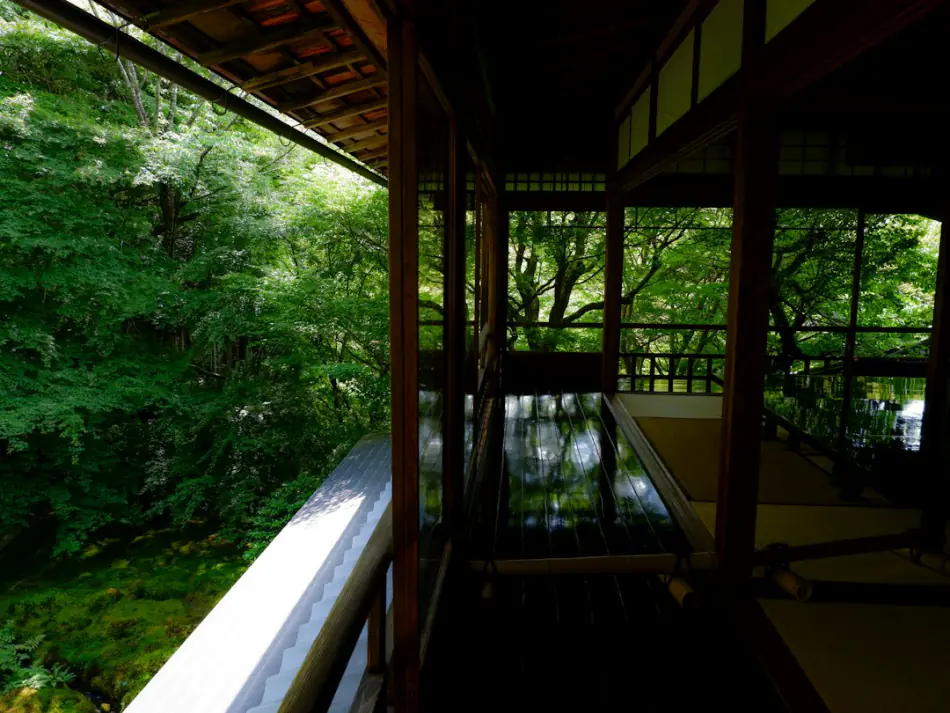
An onsen is a bath fed by natural geothermal mineral water, legally defined in Japan since the Hot Spring Law of 1948: the source water must be at least 25 °C at the point it emerges, or contain specified concentrations of particular minerals such as sulphur, sodium, iron or magnesium. That legal definition is why the etiquette is strict — the water isn’t chlorinated swimming-pool water you can shower off afterwards. It’s mineral water that flows through the bath and is shared by everyone in it, and in many traditional facilities it isn’t filtered or recirculated at all.
Once you understand that, every rule stops feeling arbitrary. The bath is not where you get clean. The bath is where you soak after you’re already clean. Everything else — the pre-wash, the towel ban, the tied-up hair — is downstream of that single principle.
It also helps to know what you’re actually walking into, because “Japanese bath” covers several different things with different prices and different attitudes:
| Type of bath | Water | Typical entry (2026) | Tattoo outlook |
|---|---|---|---|
| Onsen (public / ryokan) | Natural mineral spring, 25 °C+ at source | approx. ¥400–¥800 (range ¥200–¥2,000) | Varies by house rule — check first |
| Sentō (neighbourhood bath) | Heated tap water, no mineral requirement | Usually cheaper than onsen | Mixed; big-city sentō often relaxed |
| Super sentō (bath complex) | Often piped or trucked mineral water + saunas | Higher — more facilities included | Often the strictest on tattoos |
| Kashikiri-buro (private bath) | Same spring water, booked just for you | approx. ¥3,000–¥8,000 / 45–60 min | Always fine — no rules to break |
Prices shift by region and season, so treat those as ballpark figures for 2026 rather than fixed rates. The pattern holds, though: the more public the bath, the more the etiquette matters.
Do You Really Have to Be Completely Naked in an Onsen?
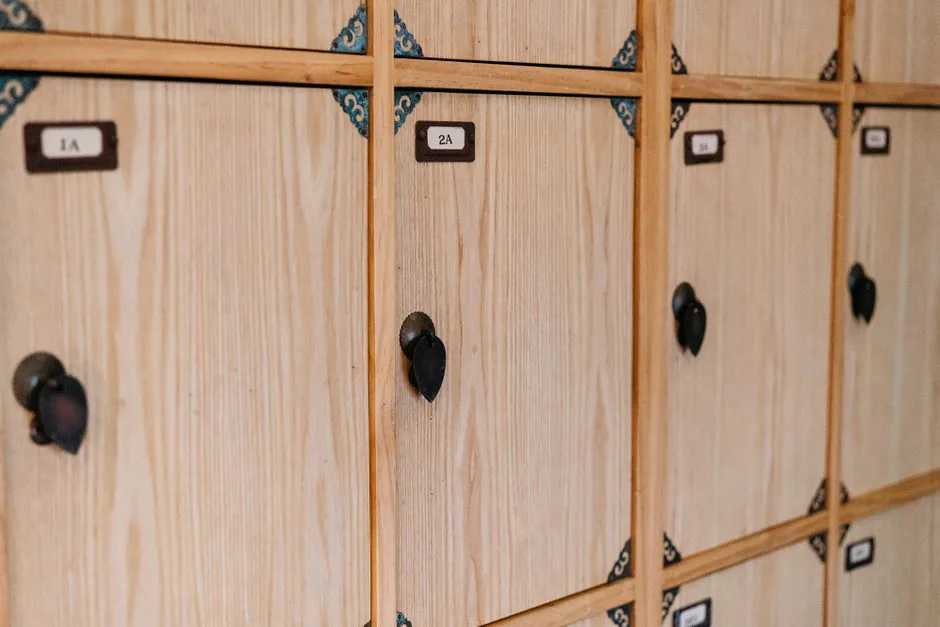
Yes — full nudity is required in essentially every traditional onsen in Japan, and swimsuits are explicitly banned. This isn’t prudishness in reverse or a quirky local preference; fabric carries detergent residue, lint and bacteria into shared mineral water, so covering up is treated as the unhygienic option. If a facility does allow swimwear, it’s a water park or a “spa resort”, not an onsen in the traditional sense.
Baths are separated by gender. Look for the noren curtain at the entrance: red or pink usually marks 女 (women), blue or dark usually marks 男 (men). Colours are not a reliable rule on their own, and some facilities swap the two baths daily so everyone gets the nicer view — check the kanji, not the colour. Mixed bathing (konyoku) was the norm historically until the Meiji government prohibited it in urban areas in 1869, and today only a small handful of facilities remain, mostly rural, mostly frequented by older Japanese men.
The towel question is where most first-timers get stuck. You’re given two:
- The large towel stays in the changing room, in your basket, dry. It’s for drying off afterwards. It never enters the bathing hall.
- The small towel (tenugui, roughly the size of a hand towel) comes in with you. Use it for washing, and hold it in front of you while walking between the washing station and the bath if you want.
The small towel must never touch the water. When you get in, fold it and rest it on the rim of the bath, or do what half the room is doing and balance it neatly on your head. It looks faintly ridiculous the first time. By the third onsen you’ll be doing it without thinking.
The practical reassurance: nobody is looking. Onsen culture runs on a concept of “naked communion” — hadaka no tsukiai — where the entire point is that status, clothes and body shape stop mattering at the door. Staring is the actual taboo. Being naked is not.
How Do You Wash Before Getting Into the Bath?
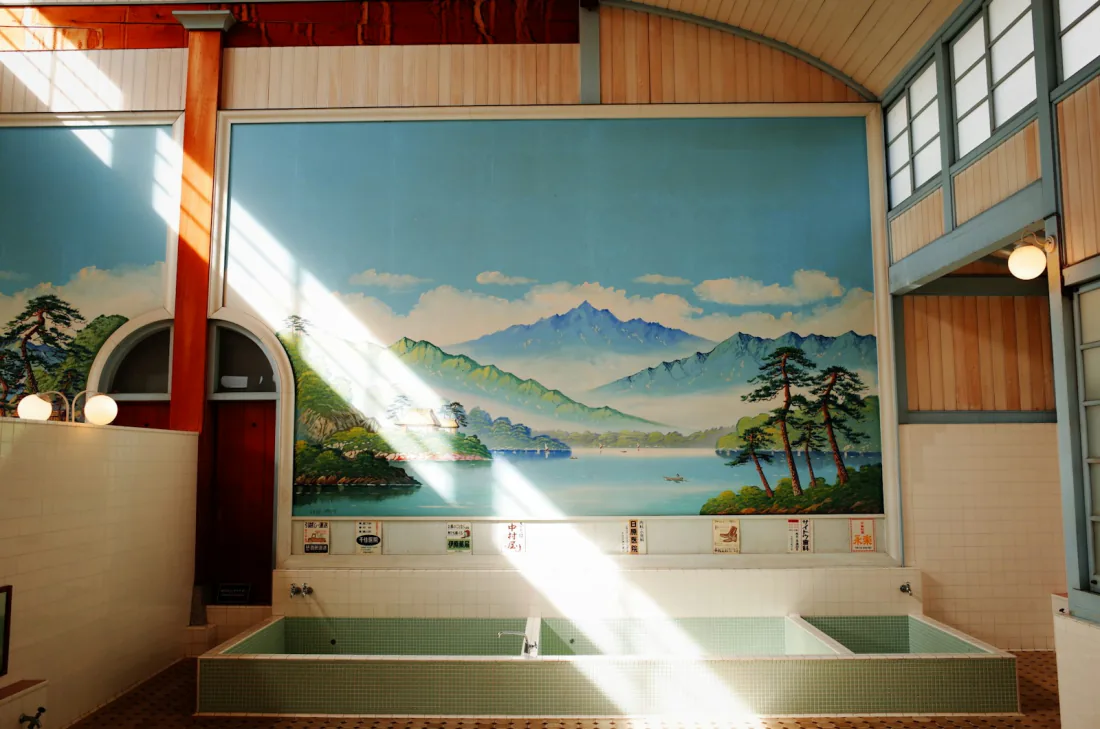
You sit on a low stool at a washing station and scrub your entire body with soap before you go anywhere near the bath — that’s the single non-negotiable rule of Japanese bathing. Each station has a handheld shower, a mirror, a small stool, a bucket, and provided soap and shampoo. Sitting matters: washing while standing sprays water and suds onto the people either side of you, which is one of the few things that will actually get you a look.
Here’s the full sequence, start to finish:
- Pay and get your shoes off. Shoes come off at the entrance and go into a locker. Pay at the counter or a vending machine.
- Undress completely in the changing room. Everything goes in the basket or locker — clothes, watch, jewellery, glasses if you like. Phones stay here, always.
- Take only the small towel in. Nothing else crosses that threshold.
- Sit and wash thoroughly. Head to toe, soap everywhere, then rinse off every trace of suds. Washing your hair is optional but appreciated.
- Tie long hair up. Hair must not touch the water — bring a hair tie, because many facilities don’t stock them.
- Rinse your stool and bucket for the next person before you leave the station.
- Enter the bath slowly. Water typically sits around 38–42 °C; ease in rather than plunging, and don’t splash.
- Soak, cool off, repeat. Around 10–15 minutes in, then sit on the edge or rinse off in cool water, then go back in.
- Don’t rinse at the end if you want the minerals to keep working — just pat dry with the small towel before you step back into the changing room, so you don’t flood the floor.
Two things trip people up. First, outdoor baths (rotenburo) are worth the walk even in winter, and especially in winter — snow falling on hot water is the whole reason people book mountain ryokan. Second, hydrate. Long soaks at 42 °C dehydrate you faster than you expect, and there’s a reason every onsen has a vending machine selling cold water and milk right outside the changing room.
Can You Enter an Onsen With Tattoos in 2026?
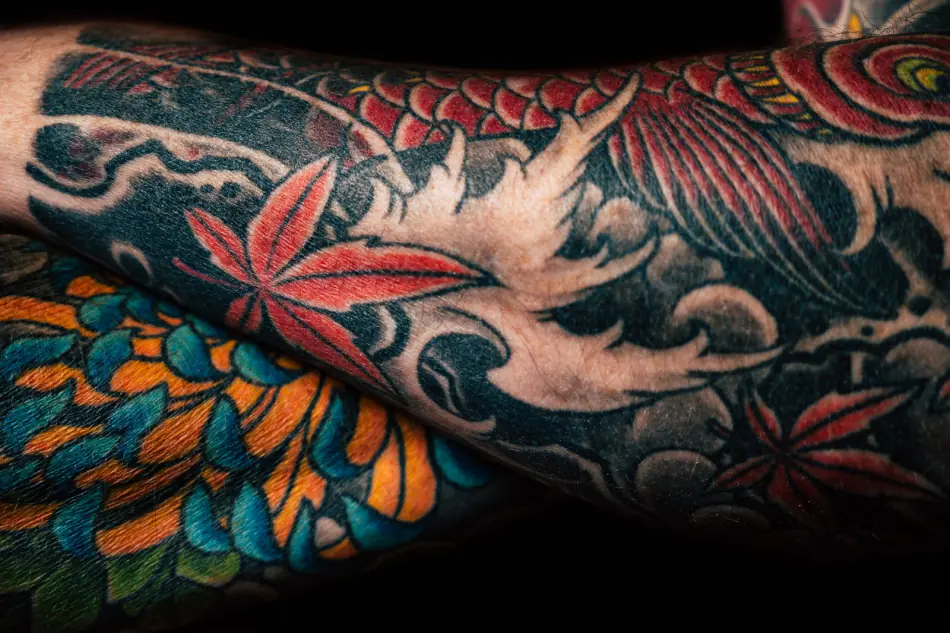
Often, yes — around half of Japanese onsen facilities now admit tattooed guests in some form, up from roughly a third earlier in the 2020s, according to tattoo-friendly onsen directories tracking the shift. The ban was never a law. It’s a house rule, rooted in the historical association between irezumi and organised crime, and it’s being quietly dropped facility by facility as international visitor numbers climb and younger Japanese get inked themselves.
The Japan National Tourism Organization has publicly addressed the topic and the general institutional direction has been to judge guests by behaviour rather than appearance. Some operators have moved faster than others: major resort chains including Hoshino Resorts have removed tattoo restrictions across their properties, and entire onsen towns have taken coordinated positions — Beppu in Kyushu, with its 100-plus public and hotel baths, actively markets itself as tattoo-friendly, and the Kinosaki Onsen Tourism Association states that its seven public soto-yu bathhouses welcome guests with tattoos.
Your realistic options, ranked by how bulletproof they are:
| Option | Works for | Reliability |
|---|---|---|
| Private kashikiri bath | Any tattoo, any size, couples, groups | 100% — no policy applies |
| Room with private open-air bath | Full sleeves, back pieces, shy bathers | 100% — costs more per night |
| Declared tattoo-friendly town or chain | Anyone wanting the communal experience | High — verify the specific bath |
| Waterproof cover stickers | Small pieces only (roughly palm-sized) | Medium — some baths accept, some don’t |
| Turning up and hoping | Nothing | Low — expect a polite refusal |
One thing that costs nothing: email or message the ryokan before you book and ask directly. Japanese hospitality businesses answer this question constantly and will tell you straight. Being turned away at the door with a group of friends waiting is far worse than one awkward email.
What Onsen Mistakes Do Foreign Travellers Make Most?
The most common mistakes aren’t about nudity at all — they’re noise, phones, and treating the bath like a pool. Here’s what actually gets noticed, in rough order of how much it bothers the room:
- Bringing a phone into the bathing area. This is the big one. Cameras in a room full of naked strangers is a hard no, and several facilities will ask you to leave. Leave it in the locker.
- Loud conversation. Onsen are quiet by default. Talk, but at a library volume.
- Dunking the small towel. Rim of the bath or on your head. Never in.
- Swimming, splashing or submerging your head. It’s a soak, not a length.
- Getting in without washing properly. A quick splash doesn’t count — soap and rinse.
- Drinking heavily beforehand. Alcohol plus 42 °C water is how people faint. Most facilities ask visibly intoxicated guests not to bathe.
- Walking back into the changing room dripping. Pat dry at the door with the small towel.
- Staring. Including at tattoos, including at other foreigners. Eyes on the water.
Worth flagging on the health side: the heat is real. Long soaks can drop your blood pressure enough to make you light-headed when you stand up, and the combination of jetlag, dehydration and a 42 °C bath catches out more travellers than you’d think. If you’re heading to remote mountain onsen where the nearest clinic is a long drive away, it’s worth checking that your travel medical cover actually applies in Japan before you go — Japanese healthcare is excellent and priced accordingly for uninsured visitors.
Getting to the good onsen is also its own small logistics puzzle. The famous ones — Kusatsu, Hakone, Kinosaki, Beppu, Noboribetsu — are spread from Kyushu to Hokkaido, so flying into the right airport matters more than usual. It’s worth comparing flight prices into Tokyo, Osaka and Fukuoka side by side rather than defaulting to Haneda, because an Osaka or Fukuoka arrival can cut hours off the train leg. If you’re mapping out a wider route, our guide to cheap flights to Tokyo covers the booking windows and which arrival airport actually costs less once the train leg is priced in.
Onsen Etiquette FAQ
Do I have to be naked in a Japanese onsen?
Yes, in essentially every traditional onsen. Nudity is mandatory and swimwear is banned, because fabric brings detergent and bacteria into shared mineral water. Baths are separated by gender, so you’re only naked around people of the same gender, and the cultural norm is firmly no-staring. If nudity is a hard limit for you, book a private kashikiri bath instead.
Can I wear a swimsuit in an onsen?
No — not in a genuine onsen. Facilities that allow swimwear are water parks, spa resorts or mixed-bathing novelty baths, not traditional hot springs. A few konyoku (mixed) baths permit a bathing wrap for women, but this is the exception and always depends on the specific facility’s posted rules.
Are tattoos actually banned in Japanese onsen?
There’s no national law banning tattoos in onsen — every restriction is an individual facility’s house rule. As of 2026, roughly half of facilities admit tattooed guests in some form, and towns like Beppu and Kinosaki have taken openly tattoo-friendly positions. Large pieces are harder than small ones, so check policies before you book, or use a private bath where the question never comes up.
Are foreigners allowed in Japanese onsen?
Yes, and the vast majority of onsen welcome international guests. A small number of rural facilities have historically posted Japanese-only signs, usually citing etiquette problems rather than nationality as such, but this is rare and increasingly unusual. Knowing the wash-first sequence removes almost every reason a facility would hesitate.
Can you go in an onsen on your period?
Convention in Japan is to skip communal bathing during menstruation, since the water is shared and often unfiltered. Tampons or menstrual cups are not considered an acceptable workaround at most facilities. A private kashikiri bath or a room with its own open-air bath solves this cleanly with no awkward conversation required.
How long should you stay in an onsen?
Around 10–15 minutes per soak is the usual guidance, then cool off before going back in. Water typically sits between 38 °C and 42 °C, which is hot enough to raise your core temperature quickly. Drink water between rounds and get out immediately if you feel light-headed — fainting in a hot bath is the genuine risk, not the etiquette.
Final Word: Just Open the Door
Onsen etiquette looks intimidating written down and takes about one visit to internalise. Wash sitting down, keep the towel out of the water, stay quiet, leave the phone in the locker. That’s 90% of it. The nudity that terrifies people beforehand stops registering roughly four minutes after you get in, and the tattoo wall that used to end the conversation now has a door in it — several, if you count private baths, tattoo-friendly towns and chains that have dropped the rule entirely.
If you’re building a Japan trip around this, do two things this week. Pick one onsen town and email the ryokan to confirm its tattoo policy and whether a kashikiri bath can be reserved with your room — ask before you book, not after. Then check flight prices into Tokyo, Osaka and Fukuoka for your dates, because the cheapest arrival airport often decides which onsen region actually makes sense. Winter is the best season for outdoor baths and the most competitive for ryokan rooms, so early beats clever.
Want more of the unfiltered stuff guidebooks skirt around? Our first-timer’s guide to FKK clubs in Germany covers another bathing culture where getting undressed is the normal part.

Gbuska is the founder and lead writer at WanderFunTrip. What began as one too many 3 a.m. festival fields and a $40 flight booked on a whim turned into a full-time habit of testing adventure trails, party cities, and adults-only resorts firsthand — then writing up what actually worked (and what didn't). Every guide here starts from a real trip or a real booking, never a press release. Usually somewhere between a departures board and the next cliff jump.


